Tuesday, February 26, 2008

See You Later, Larry


Larry Norman died early last Sunday morning.
He's been ill for a long time, and the news of his passing is no surprise. I think I'm saddest mostly because if I hadn't happened to be browsing the iMonk, I wouldn't have known. I wonder how long it would have taken to find out. It pains me to think of how much he meant to so many, and how little he is known now.

Larry virtually single-handedly invented what he called "Jesus music," which later morphed into "Christian rock" and then "Contemporary Christian music," in the late '60s and early '70s. His aim was to reach out to a disaffected generation in terms that they would understand, without worrying about whether those terms would be acceptable to established believers. They weren't. Norman's music was banned from Christian bookstores and vilified from pulpits. He was thought to be trying to bring the devil into the Church, when what he was doing was trying to bring Jesus into the world.

He chose a hard road. He could have soft-pedaled his message and sought acceptance in the secular recording industry. His talent was easily among the greatest of his generation, not merely among Christian artists. In Another Land, the final recording of the "Trilogy" that began with Only Visiting This Planet, deserves a place among the great recordings of the 1970s, containing everything from driving rock to blues to lush orchestral pieces, and even a piano jazz song ("The Sun Began to Rain"). Yet Larry had ongoing struggles with his record companies from the time that Capital Records censored the intended title of his album with the band People!: "We Need a Whole Lot More of Jesus (And a Lot Less Rock and Roll)."

Or Larry could have soft-pedaled his music to seek acceptance within the church. His label, Solid Rock Records, had produced many of the early Jesus Music pioneers: Randy Stonehill, Tom Howard, Mark Heard, Daniel Amos (psst--that last is a band, not a person). And the venture fell apart, partly due to Larry's disappointment that this younger generation of artists were becoming complaisant in the Christian world, refusing to play to secular venues on the one hand, and neglecting to give the gospel in confrontational terms in between songs. Larry simply wasn't content to lapse into Christian celebrity, and so he kept to an iconoclastic path, one that left him in relative obscurity (apart from the following he had made in his early days) and relative poverty.

Larry's music, and that of other Jesus Music pioneers, was a tremendous influence on me in my youth. I am saddened by our loss, but glad to know that he is finally in the presence of our Lord. I look forward to the day when I'm there, too. It'll be nice to meet him.

Sunday, February 24, 2008

What Does "Church" Mean?

Lately I've seen a number of discussions involving the meaning of the word, "Church." The general tenor is that a) the church is the people, not the building; and b) expressions such as "I'm going to church" reflect a lapse into thinking that it is the building after all, and not the people, a lapse which we should be avoiding.

All of this is far too simplistic. Are we talking about the biblical use of the term, the historical use of the term, the contemporary use of the term, or what we think the contemporary use of the term ought to be? Is there one acceptable use, or many? Should it be qualified by context?

For one thing, such debates ignore what is known as "lexical range." Very few words have only one acceptable meaning. Most of them are technical terms, which are coined and defined precisely so as to exclude any ambiguity. That's why legal and medical terminology uses Latin so much: language in these disciplines needs to be precise. But language as it is used in everyday situations is much broader than that. There is a range of meaning that any word can have, based on context. "I set the chess set on the TV set while I watched a set of tennis." Words don't have just one definition.

So the very question, "Is the church the people or the building?" is quite possibly a false dichotomy. It may easily refer to both, and does so in contemporary usage, whether we may like it or not. It may be better, or more biblical, for us to view the church as the people, more so than the building, but that's not the same thing as asking what the word means.

It's also worth pointing out that the phrase, "I'm going to church," doesn't necessarily reflect a focus on the building rather than the people. As a matter of fact, you'll notice that when we're going to a service, we say, "I'm going to church," but if we need to go to the same place at a time when a service is not taking place, we say, "I'm going to the church." This is not helpful if we're trying to establish that the one legitimate meaning of "church" is people, not place, but it does reflect a distinction that we are making in our minds. Going to the church is not exactly the same thing as going to church.

When people are trying to discuss the "real" meaning of words like that, what they're most often trying to do is to discuss the biblical meaning, with the underlying idea that we ought to be speaking, and therefore thinking, biblically. That's fair enough. The word used in the New Testament for Church is ἐκκλησία, ekklesia, Strong's 1577. While the root of the word may be literally translated "called out," and some have taken that to mean that the church is composed of those people who have been "called out" of the world, the usage of the word is much more mundane than that: in first-century Greek, ἐκκλησία was used for any sort of public gathering. So as believers in Jesus began meeting together, they naturally called one another the ἐκκλησία, the gathering, the assembly. It was not a technical term: the same word is used in the Greek New Testament for a mob in Acts 19:32 and a legal assembly (i.e., a session of court) in Acts 19:39. In time, the word began being used for Christians in general, and later in church history, for the places and finally buildings in which Christians gathered together.

The point I would like to make is that the biblical use of ἐκκλησία does not simply refer to the people of God. It refers to the people of God as they are assembled together. First Corinthians 11:18 makes reference to this explicitly: "When you come together as a church." Even references to the larger church composed of all believers have in view the idea of all these believers considered corporately as a single group, or body. It is for this reason that I, as an individual believer, and therefore a part of the church universal, can still say that I am "going to church"--because it is in the gathering together that individual believers become the church. We simply are not "the church" apart from one another.

Chuck Colson was once asked where his church was, and he replied, "All over the city," with the idea in mind that the church was the people. I understand his point, but I don't think it was quite correct. The church is the church only insofar as it coalesces, comes together as one. As long as we are separate individuals, each pursuing our own lives and our own relationships with Jesus, we are not "the church." It is not true, as I have heard some people say, that "I can have church out alone under a tree just as much as in a church building with a bunch of people." You may be able to have just as intense a worship experience, but that is not the same thing. The church is the church as it comes together. We need one another to be the church. We must be a part of one another to be the church. We must seek unity under the lordship of Christ to be the church. And it is that church against which "the gates of hell will not prevail."

Friday, February 22, 2008

Screwtape on Frames of Reference

In civilised life domestic hatred usually expresses itself by saying things which would appear quite harmless on paper (the words are not offensive) but in such a voice, or at such a moment, that they are not far short of a blow in the face. To keep this game up you and Glubose must see to it that each of these two fools has a sort of double standard. Your patient must demand that all his own utterances are to be taken at their face value and judged simply on the actual words, while at the same time judging all his mother's utterances with the fullest and most oversensitive interpretation of the tone and the context and the suspected intention. She must be encouraged to do the same to him. Hence from every quarrel they can both go away convinced, or very nearly convinced, that they are quite innocent. You know the kind of thing: "I simply ask her what time dinner will be and she flies into a temper." Once this habit is well established you have the delightful situation of a human saying things with the express purpose of offending and yet having a grievance when offence is taken.
--Screwtape
So, yes. There's a flip side.

Thursday, February 21, 2008

Frames of Reference

"Words, words. They're all we have to go on."
--Rosencrantz and Guildenstern are Dead
I recently had a misunderstanding with someone that's gotten me to think about the nature of communication. The odd thing about it was that the point I was trying to make had to do with exactly that--the difference between what a person thinks he has communicated to someone else and what that someone else thinks has been communicated to him. The difference between giving and receiving communication.

We've probably all had the experience of having someone say something that hit us as being insulting or rude or otherwise inappropriate, and when we call them on it, they respond, "No, no, that isn't what I meant at all." The conversation can go in many directions at that point, but isn't the feeling we usually have, when this protest is made to us, something along the lines of, "Well of course you did! What else could you possibly have meant?" We just simply cannot believe that anyone could have said those words and not meant them exactly the way they came across to us.

Of course, there will be those times in which the errant communicator is indeed, shall we say, fibbing about his original intentions. But I am also convinced that there are times when the EC truly did not mean what we so forcefully heard. Why is that? How is it that someone can say something, in all sincerity meaning one thing, and someone else can hear that same thing and just as sincerely feel that it means something completely different?
"It is impossible to say just what I mean!"
--J. Alfred Prufrock
Communication is a tricky thing. A communicator, attempting to convey a thought, a feeling, an idea, starts out with a particular frame of reference, a matrix of understanding that is a conglomeration of his personality and entire life experience, and more specifically, his experience of how words have been used toward and around him. He shapes this thought into words, the symbols by which we attempt communication, within this matrix; he says what he says because it makes sense to him to say it that way; to him, that's what the words he comes up with mean.

But the recipient takes these words into a completely different personality and life experience, into a different experience of how words have been used toward and around him. He receives the sounds, or the sight of print on paper, or on a screen, and has to create meaning out of these raw sensory impressions, and the meaning he creates has as much to do with his own matrix of understanding as it does with the actual words that have been used. To the extent that the two frames of reference are similar, the communication will be understood in the same sense as it was intended. To the extent that they differ, communication will be impeded.

It's most obvious when people speak different languages. Here, there is no common frame of reference at all, at least where language is concerned. But also, there is no real issue of misunderstanding, because there is no illusion of understanding at all. The dangerous situation--which is by far also the most common--is a partially shared frame of reference. We have just enough similar life and language experience to be dangerous. We know each other well enough to think that we know everything--or at least enough to understand what they said! And so we react, based not on the actual words that were said, but by what those words would have meant if we had ever uttered them. Coming out of our own frame of reference, saying such a thing might have been unthinkable, or would have been spoken only with a completely different intent. But we really have no way of ever experiencing anyone else's frame of reference. The closest we get to it, aside from shared experiences (we both know what "As you wish" means because we've both seen The Princess Bride), is--talking: i.e., communication, language. The very thing that seems to be the impediment is the only clue we have into one another's world.

Perhaps what we most suffer from is a lack of empathy. We simply don't have the imagination to conceive of another way of looking at life, at people, at language. Our way seems so obvious, so right! The problem is that everyone else stubbornly refuses to agree with God and me! Or perhaps it is merely inconvenient. It's easier simply to think that the other person is wrong than to think that they view things from a different point of view. It's easier simply to react than to give the other person the benefit of the doubt, to imagine what might have caused them to articulate what they did. I've found myself in the position of being a translator on numerous occasions, not between different languages, but between different frames of reference, trying to get two people to see things from one another's point of view, and it can be exhausting. But really, if we're to love our neighbor as ourselves, isn't that exactly what is being asked of us?
"That was when I learned that words are no good; that words dont ever fit even what they are trying to say at."
--Addie Bundren
Of course, I can only hope that anyone could possibly understand this.

Saturday, February 16, 2008

Listlessness

It's the obligatory "Why I haven't been posting post."

There's been a lot going on recently. My mother had major back surgery, and just as she was getting over it (quickly and wonderfully, I should add) my son suffered a broken arm, and we found out he had a bone cyst, and there was plenty of drama over the sling that the ER originally put him in, before we took him back and they replaced it with a shoulder stabilizer. (Evidently casts are now passe.) And there's also been drama over the work situation that I also make a point of not discussing here.

Anyway, I've had several ideas for posts, including
  • a snarky take on the media's questioning whether we (Americans) are "ready" for the first African-American, or woman, or Mormon (too late) president, as though we couldn't possibly decide on any other basis;
  • a humorous commentary in dialogue on people who essentially hold to inerrancy but quibble over the term;
  • a few things that I've forgotten about now
but I either never started them or started and abandoned them. I'm simply mentally and emotionally exhausted.

So in lieu of having something actually to say, I offer my first attempt at painting. Just did it on a lark. It's quite amateurish, but it was fun to do. And that, not the outcome, was the point.

Saturday, February 02, 2008

A Couple of Minor Tweaks

[Note: since making these changes and composing this post, I've finally taken a look at the site in Explorer, and found that my font changes don't seem to have any effect in that browser. So at least 2/3 of my readers--that's right, both of you--would have had no clue regarding what I was talking about. Sorry about that. Plus, in my first paragraph, I morphed from talking about what I had changed and why into talking about how to accomplish this wonderful feat in your own Blogger pages, without telling you that that's what I was describing. So there might have been hapless readers desperately trying to figure out how to do what I was describing in order to see the wonderful changes I said I had made. Well, probably not, but if you were by any chance, you have my deepest regret and sympathy. I've now carved that first paragraph into two, and added an explanatory line, to make things clearer.

On the brighter side, the printing trick seemed to have worked in both browsers. Not that anyone is going to want to print out this stuff. But still.]

I've made a couple of minor alterations to this site that I hope improve readability and usefulness. First, I've chosen 'Lucida Grande' and 'Lucida Sans Unicode' as the preferred fonts (Mac and PC, respectively) for most of the text. They're the closest thing to Optima that I can find that would be in common usage. The varying thickness of the lines gives it the readability of a typical serif font, but without all the actual serifs that sometimes don't come out well when viewing on-screen.

[If you want to achieve this stunning effect on your own Blogspot blog, here's how to do it.] Unfortunately, Blogger doesn't actually offer these two Lucida fonts as options in the "Fonts and Colors" screen of its Template tab, so you have to alter the HTML template itself. In the "Edit HTML" area, scroll down a bit to get to the "Variable definitions" section; then, in the description of fonts, change whatever sections you want from the current settings to "'Lucida Grande', 'Lucida Sans Unicode', Verdana, Sans-Serif". Make sure you back up your template before doing this; if you run into problems, check punctuation.

The other alteration is less apparent, unless you choose to print out a page. If you click on "Print Preview" from the File menu, you'll see that the blog header, sidebar, and other extraneous material will not print; instead, the main body will expand to fill the page. If you would like to do something similar on your Blogger blog, here's the code I used:

<style type='text/css' media='print'&rt;
#outer-wrapper { width: 100% }
#main-wrapper { width: 95% }
#sidebar { display:none }
#header { display:none }
#h2 { display:none }
.post-footer { display:none }
.comment-footer { display:none }
#blog-pager { display:none }
.post-feeds { display:none }
#footer { font-size:x-small }
#navbar-iframe { display:none !important }
</style>

What this is doing is adding a new CSS style sheet that only applies to printing. You can choose whatever aspects of your page you want to hide from printed output. Add this code in at the very end of the <head> section, just before the </head> code.

Friday, January 25, 2008

A Footnote

On my last post, I made the statement, "We must face facts. We will never impose the Kingdom of God on this world by force, and if it ever happens that we could actually do it by the democratic process and majority vote, we would find that we hardly needed to." I am concerned that the phrase, "We will never impose the Kingdom of God on this world by force," could be taken to mean, "I wish that we could impose the Kingdom of God by force, but alas, that is an unfortunate impossibility." That desire is certainly attributed to Evangelical Christians by many (Margaret Atwood is a prime example). Not only do I repudiate that idea, but I think that it is incomprehensible if one has a proper understanding of the Kingdom.

I'll leave a thoroughgoing analysis of the Kingdom to Scot McKnight. The most important thing is that God's Kingdom is not a set of laws or social conditions that could ever be imposed. The Kingdom is composed of people who freely receive Jesus' grace and are transformed by it. While it is true that a mass of people who were transformed by Jesus' grace would have profound effects on the society of which they were a part (witness the Christianizing of the Roman Empire), the reverse attempt to transform society by fiat, without the inward work of Jesus' grace on individuals, would merely create a cruel facade resembling only slightly the effects that true inward transformation of people would produce (uh, witness the Christianizing of the Roman Empire). Indeed, the world described by Atwood would be as horrifying to most Evangelicals--more so, in some ways--as it would to non-Christians.

So not only cannot the Kingdom be imposed by force; the Kingdom by its very nature is antithetical to the idea of imposition by force. The King, after all, had force imposed on Him, with tragic, if temporary, results. Our job is not to emulate the crucifiers, but rather the Crucified.

Tuesday, January 22, 2008

Let's Stop Looking for a Political Messiah

There was only one Messiah, and He will never be elected to the White House.

At the time He came, there were certain social problems going on, mostly related to pagans dominating the governmental and social spheres of life, lording it over God's chosen people, imposing hated taxation on them, offending their sense of decency and moral values, and threatening their unique way of life with a ubiquitous cultural diversity. They were longing for someone to break the hold of the hated pagan government and to reestablish their own separate identity; to stand against the moral filth that society was bringing to their doorstep; someone to put power in the hands of the righteous once again. And when the Messiah came, He did miracles and healings and called people to repentance, and so some were wondering if He was the one they had been hoping for. But He seemed more interested in criticizing the religious establishment than in opposing the pagan rulers, and eventually they decided that He was not the one they had been hoping for after all, and had him executed. His interrogator asked Him straight out if He were a King, and He replied that He was, but not over a this-worldly kingdom. The people had been looking for a political messiah, and He was not what they were expecting, so they rejected Him.

We may scoff at their blindness. But the lure of a political messiah is strangely attractive. Believers of both the Left and the Right (yes, Virginia, the other side does exist) have too often been enticed into believing that a politician, or a political movement, or a political stance, will accomplish the will of God on earth. The painful, slow way of reaching people's hearts, seeing them change from the inside out; we just get impatient, weary of it. The babies are being killed! the poor are being oppressed! We need to change things now!

But it's a trap. C.S. Lewis has Screwtape articulate the devil's strategy, advising Wormwood to guide his newly-Christian "patient" into one political avenue or another--it doesn't really matter which:
Whichever he adopts, your main task will be the same. Let him begin by treating the Patriotism or the Pacifism as a part of his religion. Then let him, under the influence of partisan spirit, come to regard it as the most important part. Then quietly and gradually nurse him on to the stage at which the religion becomes merely part of the "cause", in which Christianity is valued chiefly because of the excellent arguments it can produce in favour of the British war-effort or of Pacifism. The attitude which you want to guard against is that in which temporal affairs are treated primarily as material for obedience. Once you have made the World an end, and faith a means, you have almost won your man, and it makes very little difference what kind of worldly end he is pursuing. Provided that meetings, pamphlets, policies, movements, causes, and crusades, matter more to him than prayers and sacraments and charity, he is ours—and the more "religious" (on those terms) the more securely ours. I could show you a pretty cageful down here. The Screwtape Letters, No. 8
We must face facts. We will never impose the Kingdom of God on this world by force, and if it ever happens that we could actually do it by the democratic process and majority vote, we would find that we hardly needed to. Outlawing abortion or racial discrimination would not be necessary if people simply quit committing these sins. Change the hearts of people and their behavior will change. To the moral, no laws are necessary; to the reprobate, no laws will suffice. Jesus provided for us the model that we find so, so difficult to implement. Strength in weakness. Change society through its most powerless members. The blood of the martyrs is the seed of the church.

The real issue is faith. Is our faith centered on 1600 Pennsylvania Avenue, or on Golgotha?


HT: Largely inspired by a good piece by Bob Mitton on making voting a spiritual discipline, casting votes based on careful consideration of the issues, and without regard to the "electability" of the candidate, because when all is said and done, God is still on the throne.

Note: I have published a footnote to this post, in order to correct a possible misunderstanding.

Saturday, January 05, 2008

David Fitch and Confessions of a Missional Pastor

David Fitch writes an interesting piece called Confessions of a Missional Pastor. I appreciate his honesty in describing how difficult it is to attain a missional ideal. My own observation is that it is much more difficult to attain a missional ideal than it is to rail against "the institutional church." (This is no swipe against David; it's just an observation borne of seeing that sort of thing in many circumstances.) To generalize, it's much harder to attain any sort of ideal than it is to rail against the perceived reason for falling short.

Let's be blunt. The failures of the church are not the Pope's fault.
They are not Luther's fault.
They are not Calvin's fault.
They are not Wesley's fault.
They are not Edwards's fault.
They are not Finney's fault.
They are not liberalism's fault.
They are not Evangelicalism's fault.
They are not Modernism's fault.
They are not Postmodernism's fault.
They are not megachurches's fault.
They are not the United States's fault.
They are not those-other-kinds-of-Christians's fault.

They are the fault of human nature. Fallen nature. Sin nature. What we say we believe in, what most of us acknowledge that we have not fully overcome, but then think we can overcome by breaking away from some organization and "starting fresh."

The failure is not in the organization. The failure is in the fact that all organizations are populated by people. The small organization that one forms when "starting fresh" is still populated by people, and sooner or later, it will be beset by the same problems that beset larger organizations.

I think the goals that David sets out are noble. I think I agree with just about all of them. I hope he understands that these struggles are simply the result of working with, and being, people. Because the alternative is to get disenchanted, leave, go somewhere else with another smaller group, and "start fresh." And perhaps, never accomplish anything at all.

Wednesday, January 02, 2008

Iowa and New Hampshire in the US Presidential Election Process

The primacy of Iowa and New Hampshire in the US Presidential election process has got to come to an end. The way the media report the election as a horse race, they have half the candidates weeded out before 98 percent of eligible US voters have had the chance to cast a vote. One could hope for the media to report differently, but since that isn't likely, it seems that some alternative to the present system needs to be found. After all, there is nothing in the Constitution giving Iowa and New Hampshire privileged status in the election process.

Their primacy is based on nothing but tradition, and relatively modern tradition at that: New Hampshire has had the first primary in the nation since 1920, and codified that place into its own laws in 1977. (This is a little weird; what if some other state also decided to pass laws guaranteeing itself the first primary in the country? I suggest we try it, hammer it out in the courts, and get New Hampshire's law declared unconstitutional once and for all.) The Iowa Caucus has only been first in the nation since 1972. So it's not like we'd be subverting some great principle from the Magna Carta by changing things.

I suggest an alternate scenario: a ten-week primary and caucus season, with five occurring on a single day each week from the beginning to the end of the season. The order of the states would be chosen by lottery two years before each general election. This would have the following effects:
  1. Each election season would have its own order, thus changing the dynamic each time;

  2. Politicking and jockeying for position among states would be eliminated by a random drawing;

  3. The first news reports of actual voting would not be a single state's results, but rather the results of five separate contests. Since the results would most likely differ from state to state, there would be a better chance of more candidates remaining in the race for longer (they wouldn't be "eliminated" by a bad showing in a single state);

  4. There would be no "Super Tuesdays," in which nobody but those who have built up crushing war chests could compete;

  5. Neither would there be any weeks (or days) in which the outcome in a single state would dominate the news cycle.
In fact, the only downside to this process would be if several very populous states were to have early primaries, and a single candidate won them all, the election could be sewn up mathematically before most of the races had taken place. But this would be preferable to the present system, in which the illusion of inevitability is created by a mathematically insignificant portion of the populace, and gives inordinate power to the states that have chosen themselves as the bellweathers. If you doubt this, consider: only twice since 1972 has a candidate lost both Iowa and New Hampshire and gone on to win the nomination of a major party (George McGovern, in 1972, and Bill Clinton, in 1992). It's time for something different.

Tuesday, January 01, 2008

2007 on The Schooley Files

Thought I'd share a few stats about this blog, give some thanks to those who threw traffic my way, and let you know which pages you've made the most popular this year.

According to Google Analytics, I had 6447 visits with 10,625 page views. So if I keep this up for ten years, I'll have had as much traffic as one really bad day on Instapundit. 33.5% were return visitors--thanks for coming back!


Thanks to my top referring sites (not counting search engines):
  1. SBC Tomorrow (Peter Lumpkins) Peter's been a good blogging buddy since pretty soon after I got started. Even though he blogs mostly on Southern Baptist issues, we intersect on the issue of Armi uh, nonCalvinism. My promise to Peter this year: I'll stop hassling him about the use of the word, "mystery."

  2. iMonk (Michael Spencer) Michael writes as the always-intriguing Internet Monk. I admire his honesty and courage. He gave me one link this year, applauding me for standing up to John Piper's theology, perhaps not recognizing that I'm in a denomination where it would be more dangerous to stand up for John Piper's theology. At any rate, he gave me a mini-version of an instalanche, and I'm grateful.

  3. Everything That's On My Mind (Red Oaks Assembly of God blog by Pastor Bob Mitton) My pastor, blogging on my church's blog. Bob comments as "Bob2" (long story) and has been a good friend, along with his wife Lori. He got me started--click on "Why this blog?" in the categories section to see how.

  4. Jesus Creed (Scot McKnight) Scot writes the most consistently high-quality blog I've seen. The traffic from this blog comes from my own comments being clicked on, but hey, I appreciate it.

  5. Lone Prairie (Julie R. Neidlinger) Julie has become a new blogging buddy this year. She writes with sometimes painful candor, and our exchange over relationship stuff pulled me back into blogging when I was about ready to call it quits. I'm not sure whether to thank her or to blame her. Maybe both.


  6. A Church in Fort Collins I received some kind comments and emails from Nick Liquori, who was designing his church's website at the time, and chose to link to a few of my posts on divine election. Many thanks.

  7. JollyBlogger (David Wayne) David's a joy to read, despite the fact that we come from largely different perspectives. But he's got a great heart. If I were a Calvinist, I'd be a David Wayne kind of Calvinist. Perhaps someday, God will sovereignly ordain that I become one. Once again, links from my own comments drove the traffic here.

  8. Y Safle (Stephen Kingston) Stephen is a Welsh blogger, and saw my stuff early on. Too bad he has slowed down considerably in recent months. Always an interesting perspective. Might have been the first person to blogroll me.

  9. Word to the Wise (Albino Hayford) Albino's another guy who opposes Calvinism but doesn't like the name "Arminian." Fair enough. He was also kind enough to blogroll me, and has my appreciation.

Here are the most-viewed pages on The Schooley Files, according to Google Analytics:
  1. Johnny Lingo and the Ten-Cow Wife
    By far, this gets more hits than anything else; of course, it's something I didn't write, and I'm probably violating copyright law to have it on my site. But until someone hassles me about it, I still think it's a great parable for how husbands and wives ought to treat each other.

  2. Olson on Piper on God
    What can I say? Controversy sells. This is the one that iMonk linked to.

  3. An Arminian Perspective on Election, God's Foreknowledge, and Free Will
    My attempt to explain how I believe these three elements all work together.

  4. Does Your Theology Honor God?
    A moment of reflection on a correspondence I had with a convinced Calvinist. Sometimes why we believe what we believe is more important than the specifics of the hairs we're splitting. Thanks to Peter for a link to this one.

  5. Divine Election in John 3
    John 3 is typically used by Calvinists to support the position of unconditional election; I think that considered in context, it far better supports election as a divine response to trust in Christ.

  6. Tim Challies on Roger E. Olson's Arminian Theology
    Controversy again.

  7. The New Perspective and Ephesians
    This is one of the posts I'm most proud of. Part of my "New Perspective" series, it's a close examination of one of the key passages in Calvinistic interpretation. The key to understanding Ephesians 1 and 2 is to trace out and identify who are the "you" and who are the "we" and "us" referred to by Paul, and place this in the context of the integration of the Jewish and Gentile branches of the church, which forms the heart of the letter.

  8. Bono and Bill Hybels on RedBlueChristian
    For some reason, people search for this almost every day. I should put the names of famous people in the titles of my posts more often.

  9. So When Did the Wise Men Get There, Anyway?
    Seems to be a holiday favorite. Not bad, considering it doesn't even answer the question.

  10. An Alternative to Calvinism and Arminianism?
    Short answer: there isn't one. For some reason, people always want to "split the difference" between Calvinism and Arminianism--and end up with a moderate Arminian position, even though they're scared of the name.

  11. The Successes and Failures of the Reformation
    This also gets searched for a lot--I'm guessing, by Roman Catholics.

  12. The New Perspective and Romans 9: Introduction
    First of a several-part series dealing with the intricate argument Paul makes regarding election in Romans 9. My contention: if you look at all the Old Testament passages Paul cites, and understand them in context as Paul would have, you cannot come to the Calvinist position on this chapter.

  13. All the Lonely People
    Part of mine and Julie's relationship go-round. "Mr. Darcy" is evidently the "42" of relationship questions.

  14. Why I Am Not a Calvinist (With Apologies to Bertrand Russell) Part 1
    First of a two-parter, in which the intrepid blogger attempts to make a positive case for an Arminian view of election.

Anyway, thanks for reading, thanks for linking, God bless you all. I'll most likely delete it all in the morning.

Friday, December 28, 2007

Thursday, December 27, 2007

A Christmas Carol 4

`Why wasn't he natural in his lifetime? If he had been, he'd have had somebody to look after him when he was struck with Death, instead of lying gasping out his last there, alone by himself.'
The Ghost of Christmas Yet to Come appears immediately after Scrooge's visitation from the Ghost of Christmas Present; for the first time, there is not even a token return to Scrooge's bedroom. The Spirit's appearance is obviously intended to be reminiscent of the Grim Reaper, and the typical way of understanding this section is to focus on death itself: Scrooge is going to die, this fact is revealed to him over the course of several visions, it is ultimately brought home to him by his seeing his own tombstone, and he falls into a total repentance due to his terror. The only problem with this interpretation is, it's implausible.

Unlike Tiny Tim, who clearly has a disease from which, presumably, he could recover given proper medical care, there has been no hint in the story that Scrooge is ill in any way. Nor is there any explanation for his death given in the visions that the Ghost of Christmas Yet to Come shows him. Scrooge is elderly, and it appears that he simply dies from natural causes and old age. The point is, a change of heart is not going to prevent this from occurring, and nothing in the story suggests that it will. Scrooge is smart; he knows that he is elderly, and the certainty that he will one day die cannot be new to him. So having that fact pointed out by the Spirit cannot possibly have a significant effect on Scrooge. Nonetheless, the visions shown to Scrooge do have that effect. So the point of the visions must be something other than simply the fact that Scrooge will die.

The Spirit first shows Scrooge some seemingly random conversations among businessmen, discussing the death of someone they knew.

`It's likely to be a very cheap funeral,' said the same speaker; `for upon my life I don't know of anybody to go to it. Suppose we make up a party and volunteer?'

`I don't mind going if a lunch is provided,' observed the gentleman with the excrescence on his nose. `But I must be fed, if I make one!'

Another laugh.

`Well, I am the most disinterested among you, after all,' said the first speaker, `for I never wear black gloves, and I never eat lunch. But I'll offer to go, if anybody else will. When I come to think of it, I'm not at all sure that I wasn't his most particular friend; for we used to stop and speak whenever we met. Bye, bye.'

And from another conversation,
`Well,' said the first. `Old Scratch has got his own at last, hey?'

`So I am told,' returned the second. `Cold, isn't it?'
The discussions are not merely about the death of someone: they are disinterested discussions. The general mood is indifference.

The Phantom next leads Scrooge to a rundown shop in a bad section of town, in which three people meet to sell some wares to Old Joe, the proprietor. It soon becomes evident that what they are selling they have stolen from the dead man. The items produced by the first two are simply odds and ends, but the last woman produces bed curtains and blankets from the bed on which the dead man was lying, and the shirt that had been put on him for burial.
`Ha, ha!' laughed the same woman, when old Joe, producing a flannel bag with money in it, told out their several gains upon the ground. `This is the end of it, you see. He frightened every one away from him when he was alive, to profit us when he was dead! Ha, ha, ha!'
And then suddenly the Ghost and Scrooge are in a room alone with a corpse, covered with a sheet.
He thought, if this man could be raised up now, what would be his foremost thoughts? Avarice, hard-dealing, griping cares. They have brought him to a rich end, truly.

He lay, in the dark empty house, with not a man, a woman, or a child, to say that he was kind to me in this or that, and for the memory of one kind word I will be kind to him.
The Spirit indicates for Scrooge to move the sheet and reveal the face of the dead man, but Scrooge can't. Instead, he begs the Ghost to show him someone who feels emotion at the man's death. The Spirit shows him a conversation between a man and his wife.

`We are quite ruined!'

`No. There is hope yet, Caroline.'

`If he relents,' she said, amazed, `there is. Nothing is past hope, if such a miracle has happened!'

`He is past relenting,' said her husband. `He is dead.'

She was a mild and patient creature if her face spoke truth; but she was thankful in her soul to hear it, and she said so, with clasped hands. She prayed forgiveness the next moment, and was sorry; but the first was the emotion of her heart.

"The only emotion that the Ghost could show him, caused by the event, was one of pleasure." Scrooge then begs to see "some tenderness connected with a death," and is shown Bob Cratchit's house, in which is being mourned the recent death of Tiny Tim. By contrast to the dark, empty room in which the dead man had lain, the room in which Tiny Tim is lying
was lighted cheerfully, and hung with Christmas. There was a chair set close beside the child, and there were signs of some one having been there, lately. Poor Bob sat down in it, and when he had thought a little and composed himself, he kissed the little face.
So Scrooge finds tenderness, but not for the man lying on the bed.

The Spirit finally conveys Scrooge past his place of business and his home, to a churchyard. "It was a worthy place. Walled in by houses; overrun by grass and weeds." Before even seeing the stone, Scrooge begins to plead with the Ghost. But in all his pleading, Scrooge never once mentions dying, or expresses a wish not to die. What he asks is, "Am I that man who lay upon the bed?"

It is not merely the fear of death that so affects Scrooge: it is the fear of being alone, uncared for, unmourned; that no one will have any emotion other than relief or satisfaction from his death. It is being cut off from all of humanity, and all his wealth having become meaningless. He has finally understood that while he can manipulate and control people through his wealth during his lifetime, only kindness and participation in their lives can gain any reciprocal kindness from them once he dies. He wants, not never to die, but to have been a part of others' lives when he does.

It is worthwhile to look at our own dealings with others. If we hold people at a distance, use them for our own ends, manipulate them to do what we want, ignore them when they're inconvenient, place wealth or personal possessions or accomplishments higher than them, then we have no cause to expect or hope for their kindness to us when we are in need, or past needing anything in this world. Our net worth is not something to be found in bankbooks and ledgers; it is to be found in the place we've made for ourselves in others' hearts. Our accomplishments and accumulations mean nothing if they are not valued by others, and we create value only by investment--investment in the hearts and lives of others.

This insight, by the way, is not merely of temporal value, or related only to people's thoughts and memories of us after we are gone. 'I tell you the truth, whatever you did for one of the least of these brothers of mine, you did for me.'

Thursday, December 20, 2007

A Christmas Carol 3

`Is there a peculiar flavour in what you sprinkle from your torch?' asked Scrooge.
`There is. My own.'
`Would it apply to any kind of dinner on this day?' asked Scrooge.
`To any kindly given. To a poor one most.'
`Why to a poor one most?' asked Scrooge.
`Because it needs it most.'
The Ghost of Christmas Present represents the sheer joy of the holiday. What the Ghost does is relatively simple: he merely shows Scrooge other people who are enjoying Christmas with one another. In some ways, this is the most far-ranging portion of the novella; we are given the impression that the Spirit shows Scrooge a multitude of people and celebrations over a large area. The main point is that people are enjoying themselves together, and there is little relationship between their financial situation and the joy they experience--except for the fact that poverty can endanger the actual lives of those in its clutches, and thus cause grief, opposing joy. But wealth in no way ensures joy; in fact, all the people Scrooge sees are less well-off than he is, and full of much more joy.

But the two main places that the Spirit takes Scrooge are the houses of Bob Cratchit and Scrooge's nephew. At Bob Cratchit's house, Scrooge becomes acquainted with his clerk's family. Bob's wife is "dressed out but poorly in a twice-turned gown, but brave in ribbons, which are cheap and make a goodly show for sixpence"; his oldest son Master Peter Cratchit is proudly wearing his father's shirt, with a "monstrous shirt collar" playing a prominent role in the day's festivities; Martha and Belinda, the older girls; two smaller Cratchits, a boy and a girl; and Tiny Tim, the youngest son, crippled by an unknown illness. Charges that A Christmas Carol is overly sentimental may derive from Dickens's portrayal of poor characters, and Tiny Tim in particular, as impossibly virtuous. But the description of the joy and pleasure of the Cratchit's feast is wonderful, despite the fact that the foods described are those accessible to a poor family.
There never was such a goose. Bob said he didn't believe there ever was such a goose cooked. Its tenderness and flavour, size and cheapness, were the themes of universal admiration. Eked out by apple-sauce and mashed potatoes, it was a sufficient dinner for the whole family; indeed, as Mrs Cratchit said with great delight (surveying one small atom of a bone upon the dish), they hadn't ate it all at last. Yet every one had had enough, and the youngest Cratchits in particular, were steeped in sage and onion to the eyebrows.
And about the Christmas pudding, "Everybody had something to say about it, but nobody said or thought it was at all a small pudding for a large family. It would have been flat heresy to do so. Any Cratchit would have blushed to hint at such a thing."

The point to be made upon Scrooge is that the Cratchits are altogether unlike his own discontent self:
They were not a handsome family; they were not well dressed; their shoes were far from being water-proof; their clothes were scanty; and Peter might have known, and very likely did, the inside of a pawnbroker's. But, they were happy, grateful, pleased with one another, and contented with the time.
At the house of Scrooge's nephew, Scrooge learns that his own position is not only not shared by others, but can be positively comical to them:

`He said that Christmas was a humbug, as I live!' cried Scrooge's nephew. `He believed it too!' [...] `He's a comical old fellow,' said Scrooge's nephew, `that's the truth: and not so pleasant as he might be. However, his offences carry their own punishment, and I have nothing to say against him.'

`I'm sure he is very rich, Fred,' hinted Scrooge's niece. `At least you always tell me so.'
`What of that, my dear?' said Scrooge's nephew. `His wealth is of no use to him! He don't do any good with it. He don't make himself comfortable with it.'
Scrooge enters in to the singing and the merriment of this party which he had steadfastly refused to attend on Christmas Eve afternoon, even though he is the butt of the Yes and No game. Once he has been persuaded to measure things on a basis other than that of money, he finds a great deal of joy in many things he had disdained for many years.

On two occasions, the Spirit has occasion to repeat Scrooge's words from the beginning of the story. The first is when Scrooge asks whether Tiny Tim will die, and is told that he will not last until the next Christmas: "If he be like to die, he had better do it, and decrease the surplus population."
`Man,' said the Ghost, `if man you be in heart, not adamant, forbear that wicked cant until you have discovered What the surplus is, and Where it is. Will you decide what men shall live, what men shall die? It may be, that in the sight of Heaven, you are more worthless and less fit to live than millions like this poor man's child.'
And then later, when the Spirit shows Scrooge the two children Ignorance and Want:

`Have they no refuge or resource?' cried Scrooge.
`Are there no prisons?' said the Spirit, turning on him for the last time with his own words. `Are there no workhouses?'
I wrote earlier that Scrooge was not merely a miserly, crotchety old man; that he actively enjoyed his own malevolence. Yet even he did not recognize the damning impact of thoughts and attitudes such as his. His cruelty was to dismiss others less fortunate than himself, assuming them to be lazy or otherwise unworthy, and thus suffering justly the consequences of their own decisions. And then he thinks no more of them. But those others have to live out the implications of Scrooge's thoughtlessness. Having been to Bob Cratchit's home, he now cares whether Tiny Tim will live or die; if he had not gone there, Tim would have died without Scrooge having ever known about it. Those are the implications of such thoughtlessness, as Dickens presents it.

I see an attitude growing today: whether the liberal attitude, "You can't tell me what to do with my body," the conservative attitude, "You can't tell me what to do with my money," or the libertarian attitude, which says both. The attitude, at bottom, is this: "I am me, alone; I am not part of anything larger; I owe nothing to anyone apart from myself." This is Scrooge's attitude. And it would be funny, if it weren't so sad.

The gift-giving and get-togethers and festivities at Christmas, hopefully, remind us that we are not merely ourselves, and that we have a responsibility to others. Paul writes in Galatians 2:10, "All they [the Jerusalem apostles] asked was that we should continue to remember the poor, the very thing I was eager to do." When's the last time you heard an evangelical pastor preach on that verse? We are not alone. If we are salt and light, then we are called to salt and enlighten something other than ourselves. May we enjoy, in our festivities, our connectedness with others, and may we touch lives, as best we can, for their benefit and encouragement.

Monday, December 17, 2007

A Christmas Carol 2

"I release you. With a full heart, for the love of him you once were."
--Belle, to her erstwhile fiance Ebenezer Scrooge

The Ghost of Christmas Past takes Scrooge on a journey through various Christmases of his earlier life. The temptation of a 20th or 21st century author would have been to "psychologize" Scrooge, to see what terrible circumstances in his youth had made him into the man he now is. To some degree, this does happen in this section of the novella, but Dickens does more than merely blame Scrooge's demeanor on a bad upbringing. He deals with Scrooge's responses to life experiences.

Scrooge first sees himself as a child, abandoned at a boarding school, unable to return home for Christmas, with only his books for companions. His mother has evidently died, and his father, possibly grieving, refuses to allow him to come home. While young, he populates his time with the imaginary inhabitants of his books; a few years older, he spends his time "walking up and down despairingly." But on the latter occasion, his sister Fan arrives to bring him home, since "Father is so much kinder than he used to be." So although he has had painful experiences, he chooses his response to them, and good things happen as well as bad.

In the next vision, Scrooge sees himself at the warehouse where he had been apprenticed. His boss, Old Fezziwig, puts on a Christmas party for his apprentices, his family, and their servants and neighbors. Dickens describes the party in some detail, and portrays both the younger and older Scrooges entering into the festivities wholeheartedly and praising Fezziwig lavishly. When the Spirit asks why he should be praised so highly for spending only a modest amount, Scrooge responds, "He has the power to render us happy or unhappy; to make our service light or burdensome; a pleasure or a toil.... The happiness he gives, is quite as great as if it cost a fortune."

The next sequence, however, indicates more than any other the change that makes Scrooge become the man we are introduced to in the beginning of the story. Scrooge is forced to watch as his former fiancee, Belle, breaks off their engagement. Her reasoning is telling:
`Another idol has displaced me; and if it can cheer and comfort you in time to come, as I would have tried to do, I have no just cause to grieve.'

`What Idol has displaced you?' he rejoined.

`A golden one.'

`This is the even-handed dealing of the world,' he said. `There is nothing on which it is so hard as poverty; and there is nothing it professes to condemn with such severity as the pursuit of wealth.'

`You fear the world too much,' she answered, gently. `All your other hopes have merged into the hope of being beyond the chance of its sordid reproach. I have seen your nobler aspirations fall off one by one, until the master-passion, Gain, engrosses you.
Scrooge is afraid of falling back into poverty, so he has focused all his energies into gaining wealth. His "nobler passions" have been displaced by this overriding concern. Belle recognizes that the man he has now become would never have chosen her, "a dowerless girl," to marry. All he cares about is money. He has lost the capacity to value anything else.

The final vision is the only one in which Scrooge's younger self is not present. It functions as an epilogue to the last one. We have already seen where Scrooge's path has taken him; now we see Belle with husband and family. This is the life Scrooge could have had; one which he gave up for what he has now. The time frame is seven years earlier; Marley is lying on his deathbed, and even Belle's husband pities Scrooge, who is "quite alone in the world."

Scrooge gains one major thing in this section of the novella: he relearns the ability to view things from outside his own point of view. He recognizes himself as someone who could be seen as pitiable, not simply as the astute businessman he had regarded himself as before. More importantly, he learns to identify with others. He sees them in the images of his earlier self and in the people who were parts of his life before. His young self alone at the boarding school makes him think of the caroler whom he had frightened away; his sister fan makes him think of his nephew; his regard for Fezziwig makes him think of his own relationship with Bob Cratchit. In each case, he wishes he could have taken a different approach with someone he had met earlier in the day. That ability--to see ourselves in others, and to see ourselves as others see us--could have changed his whole life.

How often do we get stuck in our own heads, seeing only our own point of view? How often do we dismiss others' feelings and concerns, just because they don't fit the template of what we consider important? And in what ways have we changed, slowly, imperceptibly, over time? We focus on something because it seems necessary, because we're afraid of what will happen to us if we don't focus on it. And then it becomes the only way in which we can view life. It's so easy for our "nobler passions" to be replaced. We need consciously, actively, to fight that tendency and keep that from happening.

Sunday, December 16, 2007

A Christmas Carol 1

Darkness is cheap, and Scrooge liked it.
I've read Charles Dickens's A Christmas Carol many times since I was young, I recently had the pleasure of reading it aloud to my family, and my pastor is doing a sermon series on it. Although it contains few references to The First Christmas, and was never intended by Dickens as a vehicle for the gospel, I believe that there is a great deal of truth in it. It's one of the books that I return to repeatedly throughout life.

I've never really liked any of the film adaptations of the story that I've seen. The George C. Scott version I think perhaps best gets at Scrooge's character, but I've always thought that Jack Nicholson would be the best actor to play the role. Scrooge is not merely a miserly, crotchety old man; he's deliberately mean, nasty, and vicious--in Dickens's words, "Scrooge! a squeezing, wrenching, grasping,scraping, clutching, covetous, old sinner! Hard and sharp as flint, from which no steel had ever struck out generous fire; secret, and self-contained, and solitary as an oyster." He's not just thoughtless and accidentally or unintentionally cruel; he positively delights in his own malevolence.

In the opening section of the book, Scrooge has four encounters as he winds down the workday on Christmas Eve. First his nephew, who angers Scrooge by inviting him to Christmas dinner (and by being genuinely merry and in love, although poor--things that Scrooge once was, himself, we will discover). Two portly gentlemen, taking up a collection for the poor, are met with Scrooge's heartlessness: "Are there no prisons? Are there no workhouses?" Then a caroler begins singing outside Scrooge's door, only to flee in terror as Scrooge seizes his ruler as if to go after the singer. Finally, Scrooge confronts his clerk, reproaching him for wanting "the whole day" on Christmas, and to be paid for it.

We see here in Scrooge human nature in its worst form. He's not merely miserable himself; he hates happiness in others, as represented by his nephew. He's not merely miserly himself; he hates generosity, and has "an improved opinion of himself" for his sharp rebuke of the portly gentlemen. He's not merely unwilling to enjoy the music of the season; he must violently banish it from his presence. And as wealthy as he is, and as poor as his clerk is, he still considers it a type of theft--"picking a man's pocket every twenty-fifth of December"--to be obliged to give a paid day off. Above all else, Scrooge is resentful--resentful of anyone or anything who makes any sort of claim on him, and anyone or anything who has anything he does not, including simple good cheer.

All of which would merely be funny, if it didn't ring true. Who among us hasn't felt grouchy and irritated at some stupid-looking happy person? Who hasn't wanted, on occasion, to wipe the smile off the face of someone? There is more Scrooge in us than we'd like to admit.

When Scrooge goes home, he is confronted by the ghost of Jacob Marley, his former partner who had died seven years earlier. The device that Dickens uses to represent Marley's sufferings is a chain composed of "cash-boxes, keys, padlocks, ledgers, deeds, and heavy purses wrought in steel." Marley informs Scrooge that the chain he bears was fully as long as Marley's seven years previously, and has grown steadily since then. The sin of Scrooge and Marley was to have nothing but mercenary goals: Scrooge had earlier protested to the portly gentlemen that the welfare of others was not his business--"It's enough for a man to understand his own business, and not to interfere with other people's. Mine occupies me constantly"; Marley retorts, "Mankind was my business. The common welfare was my business; charity, mercy, forbearance, and benevolence, were, all, my business."

Although not a man of "business" in Scrooge's sense, I am a very private person. Early life experiences of rejection taught me to leave others alone and want to be left alone myself. I am the type to have a few close friends. There's nothing, by itself, wrong with that; not everyone has to be a social butterfly, and one can't have deep friendships with everyone. Nonetheless, if my tendency toward solitude has the effect of isolating me and numbing me from the needs of others, then it's profoundly wrong.

We evangelicals have separated the "social gospel" from the Gospel, and in so doing, have divorced ourselves from a great deal of what Jesus taught, and what the Bible as a whole teaches. Jesus didn't say, "Tell everyone to repeat the Sinner's Prayer"; He did say, "Love your neighbor as yourself" and illustrated that love by the actively helpful actions of the Good Samaritan. He did say, "Do to others as you would have them do to you." He separated the sheep and the goats by the actions they took for the benefit of others. Attending to the Gospel would seem to involve attending to the "social gospel," and historically, it did so. It seems that that has been forgotten in recent decades, though. We identify with the interests of Scrooge--lowering taxes, blaming poverty on laziness--more than the interests of Bob Cratchit.

Perhaps if we emphasized what Jesus did, we'd secure an easier hearing for the Gospel.


Technorati Tags: , , ,

Friday, December 14, 2007

What Do You Want for Christmas?

Isn't that a strange question? "What do you want for Christmas?" Not, "What are you giving someone else for Christmas?" or "What are you most thankful for this Christmas?" Or even, "What do you hope your friends and family receive this Christmas?" No. It's, "What do you want for Christmas?" Because, of course, Christmas is all about getting stuff. And not just any stuff. The stuff you want.

It makes sense, I guess, if you're talking about Secular Christmas. But even then, the focus is, or used to be, on gift giving. We've made it about gift receiving. Of course, we're brought up that way and bring up our children that way. We ask them the Insidious Question, without thinking about its implications. We bring them to the Mall Santa for the expressed purpose of him asking them that question. We simply want to know what they would like; we want to get them what would make them happy.

Which would be okay if we sloughed off that attitude as we grew up. But Americans are now in the habit of never growing up. Throughout life, it's, "What do I want?" We hint, we connive, we read the ads and lust after the new toys or gadgets or fashions that are being displayed to whet our appetites. Christmas is an excuse to Get What I Want. It performs the same function as President's Day or Labor Day, only on a grander scale. It's the granddaddy of all marketing tools.

One sees the attitude in its rawest form in the way gifts are received. The disgusted expressions when a gift received is not What I Wanted. Or maybe it's not the right color or the right style. That's why it's so important to have that gift receipt, to preserve the fiction that the recipient does not know and should not care how much the gift cost, but is able to return the gift and so procure what was Really Wanted. I know, I know, sometimes it's a size issue, or duplicate gift issue. Not all returns are Bad Things. But really, where did we ever get the idea that a gift was anything other than a gift? That we shouldn't be appreciative of a gift just because it was given and because there was no obligation to give anything at all?

But of course, that lack of obligation that marks a True Gift is exactly what we don't want at Christmas. At least in our language we've become honest enough to call gifts what they are: exchanges. We don't give gifts, we exchange them. "I'll get you what you Really Want, if you get me what I Really Want, and then we'll both be happy." Until the bill comes.

So it merely makes sense that we end up just getting gift cards. Why bother shopping if the recipients are merely going to return the item and shop for themselves anyway? Perhaps a shopping spree is, in the end, what they Really Want. Eventually, maybe we'll all just cut out the middlepeople and just buy stuff for ourselves at Christmas. It would save everyone a lot of work.

But if you're celebrating Christian Christmas, I don't see how this whole mindset can enter the picture. Christmas is the day on which we celebrate the greatest gift God ever gave to us humans. "What do I want for Christmas? What do you mean? I've already received it--or rather, Him." It's not what we want, but what we have already been given, that we are celebrating. And it's worth celebrating, joyfully celebrating, and by all means, let's give gifts in the process. But let's give them without expectation of return, and let's receive them as gifts--as something unearned, to be enjoyed freely and thankfully. Let's not worry about what we want for Christmas. Let's give what we can and enjoy what we have received, from the gracious hand of our Father, who loves us and gave His Son for us, so we could have life, and life more abundantly.


Technorati Tags: , , ,

Thursday, November 22, 2007

Gratitude

It seems to me that the basic Christian mindset is, or ought to be, gratitude. What are we Christians, anyway? What defines us? Isn't it the fact that, completely apart from any merit of our own, we trust in Jesus' sacrifice for our sins? In other words, our only standing before God--the only thing that sets us apart and gives us hope for eternal life--is having received a gift. A gift of infinite value to us and inestimable cost to the Giver. A gift that we could not possibly deserve--a gift that was necessary precisely because we did not deserve it.

What possible response should that engender apart from gratitude? Certainly not the religious, moralistic pride that all-too-often we can exhibit. We forget that we are a community of sinners before we become a community of saints, and that anything good in us is a gracious gift of God.

I think every other aspect of the truly Christian mindset springs from gratitude. Joy, for example. Can a person who is unthankful be truly joyful? I know that in my own life, moments of pure joy are those in which I am the most conscious of having been richly blessed, having received what I did not earn. Or love. The more conscious I am of being a recipient of God's love, unmerited, undeserved, the more easily I can share this love with others, without regard for whether I think they deserve it. It doesn't matter: freely, freely, I have received, which helps me to freely, freely give.

And so, amidst the feasting and football, whatever our circumstances or station in life, lets remember, not Pilgrims and Indians, but God's truly rich blessings on us. And may we all have a most blessed day of Thanksgiving.

Earlier Thanksgiving posts: Don't "Happy Turkey Day" Me! and 40 Things to be Thankful For.


Technorati Tags: , ,

Friday, November 16, 2007

Thoughts on Primary Voting

Ben Witherington's Voter's Guide for Thinking Evangelicals is a worthwhile read. A few salient points (these are mine, although they overlap with Dr. Witherington's and his post is my jumping-off point):
  1. Don't be a one-issue voter. It's my conviction that politicians have used certain wedge issues to secure the votes of people whose interests and priorities overall they have no intention of representing. Bluntly put, if Republicans have the votes of Evangelicals in their hip pockets because of the abortion issue, they don't actually have to do anything about abortion. In fact, it's against their own interests to do so--because it would rob them of the issue over which they gained a voting bloc in the first place. It's in their interests to keep the "struggle" going as long as possible, to keep that voting bloc faithful, while at the same time "reaching out" to those who differ on the abortion issue and growing that "big tent." Which is exactly what's been going on for years, perhaps decades, now.

  2. Vote based on issues that the office being run for actually has influence over. Once again, using abortion as a touchstone (and only one of many possible examples), the Presidency has practically no influence over this issue. The most that can be hoped for is that Supreme Court justices are elected who overturn Roe, which, if it happened, would relegate the issue to the states and remove the President and the Federal government from the issue entirely. On the other hand, there are many, many issues over which the Presidency does exert great influence: foreign policy, for example. We should vote based on what the duties of the office entail.

  3. In primaries, vote for the candidate you genuinely would like to see win. It is mind-boggling to me that long before a single primary or caucus vote has been cast, people are already advocating voting based on "electability." "I'm not happy about some of Candidate Y's positions, but he's our best hope of beating Candidate X."[1] What are we doing when we say that? Yes, in the general election, there may be times to hold our noses and vote for the lesser of two evils, but in the primaries, we need to give the candidate whom we can most truly support our support. The worst that can happen is that a party chooses a nominee that will get defeated in the general election, while a more "moderate" candidate could have won (e.g., the Republicans choosing Goldwater in 1964). However, that can be a bellwether for a political shift (e.g., the Republicans choosing Reagan in 1980).
Anyway, those are my thoughts.

[1] "Candidate Y" and "Candidate X" morph over time; two very plausible present contenders would be "Rudy" and "Hillary." Which is why the "Y" and the "X" were interposed. To be chromosomally correct.

Thursday, November 15, 2007

Love and the Pro-Con List

Julie has another terrific post, this time about expectations of singles for marriage, especially among Christian singles. Well worth checking out. I'm going to do a bit of fisking here, but in a good way.

Julie writes,
During my first year of college (which was a Bible college), there was a girl named April who firmly believed that she was so special and unique in God's sight -- this had been drummed into her head by well-meaning parents, teachers, and youth pastors trying to protect their young flock -- that her list of qualifications for a guy was incredibly long and incredibly impossible. Nothing but the best for her, she insisted, pointing out that God wanted the best for his daughters. April did not have any comparative list of such actual qualities in herself.
Just so. I've observed before that everyone is always looking for the "right person" for himself or herself; hardly anyone is looking to become the "right person" for someone else. Which, when you think about it, is pure selfishness: I want precisely what I want, at the least possible cost or annoyance to me. What's more, that process of becoming "right" for one another doesn't end with an engagement, or even a wedding. It's a lifelong process of learning, growing, reacting, rebuking, and generally becoming intertwined.

Think about it. People are fluid. You're not the same as you were a decade ago. You won't be the same in another decade. How can you possibly know what future-you will need or value most? How can you know if future-him or future-her will be able to provide it? So how can a list, based on present-day needs and expectations, possibly forecast the future?

At some point, we have to realize that the process of becoming one is a lifelong process, directed by God, sometimes painful to our individual desires, but nonetheless beautiful, wonderful, and eminently worthwhile. I don't know who I would be without Cecile in my life for the past eighteen years; I'm not sure I want to know.

Too often the phrase "God has called me to be single" is a Bible-laced excuse to continue being selfish, fearful, proud, and content with smooth sailing. Many beautiful books and web sites by lovely men and women discuss singlehood as if we were all Paul, mysteriously and unfairly going through life without the healing of our affliction.
Yes. Reread 1 Corinthians 7. Does Paul ever say that singleness was to be pursued for its own sake? That it's a spiritually superior mode of being? No. All his reasons for preferring and advocating singleness are practical. Singleness is practically preferable for a dangerous, itinerant ministry like Paul's (you don't have to worry about how your family will be provided for while you're being thrown in jail, thrown out of town, and shipwrecked) and in times of persecution (you don't have to worry about what will happen to them if you're beheaded). It allows you to focus on service to God, exclusively. So if someone genuinely has that gift and is genuinely called to be single, then they will also be called to some form of ministry that makes apparent why marriage would be significantly detrimental in that situation.

I'm not saying that everyone who is not specifically called to singleness must get married by age x, to the first available candidate. I am saying that avoiding marriage out of fear and selfishness, and calling it a calling, is wrong. Marriage and parenthood are two of the most powerful tools God uses to get our focus off of ourselves and make us part of something larger. They teach us things that are difficult to learn in any other way.
The Evangelical world should stop having singles ministry that encourages singles to stay single and get their weekly relationship fix over pizza or coffee with the rest of the group -- sans any icky side effects from commitment -- and instead tell them to quit waiting for "the right one" and get over themselves and get married to a good and decent one.
Oh yes. What biblical justification is there, anyway, for this concept of "the right one"? That if you don't marry the one person in six billion that God has Specially Chosen Just for You, that life will be toast? As Julie says, we've become "vast herds of terrified, lonely, confused people insisting that good people right beside them simultaneously moving in the same direction are not the right people." If we find someone who is good and decent and loves God and we're genuinely attracted to them and we share interests and like being together, then that should be enough to start on. God will take care of the rest.

Please understand. I'm not saying take the plunge hastily or thoughtlessly. And we are entitled to our own preferences. But somehow, because of fear of making a mistake, we've forgotten that marriage is also a gift. A really, really good gift.

Kudos to Julie. Brave words, coming from someone who is single herself. So far. Check out the entire post; there's a lot more there.
 
 
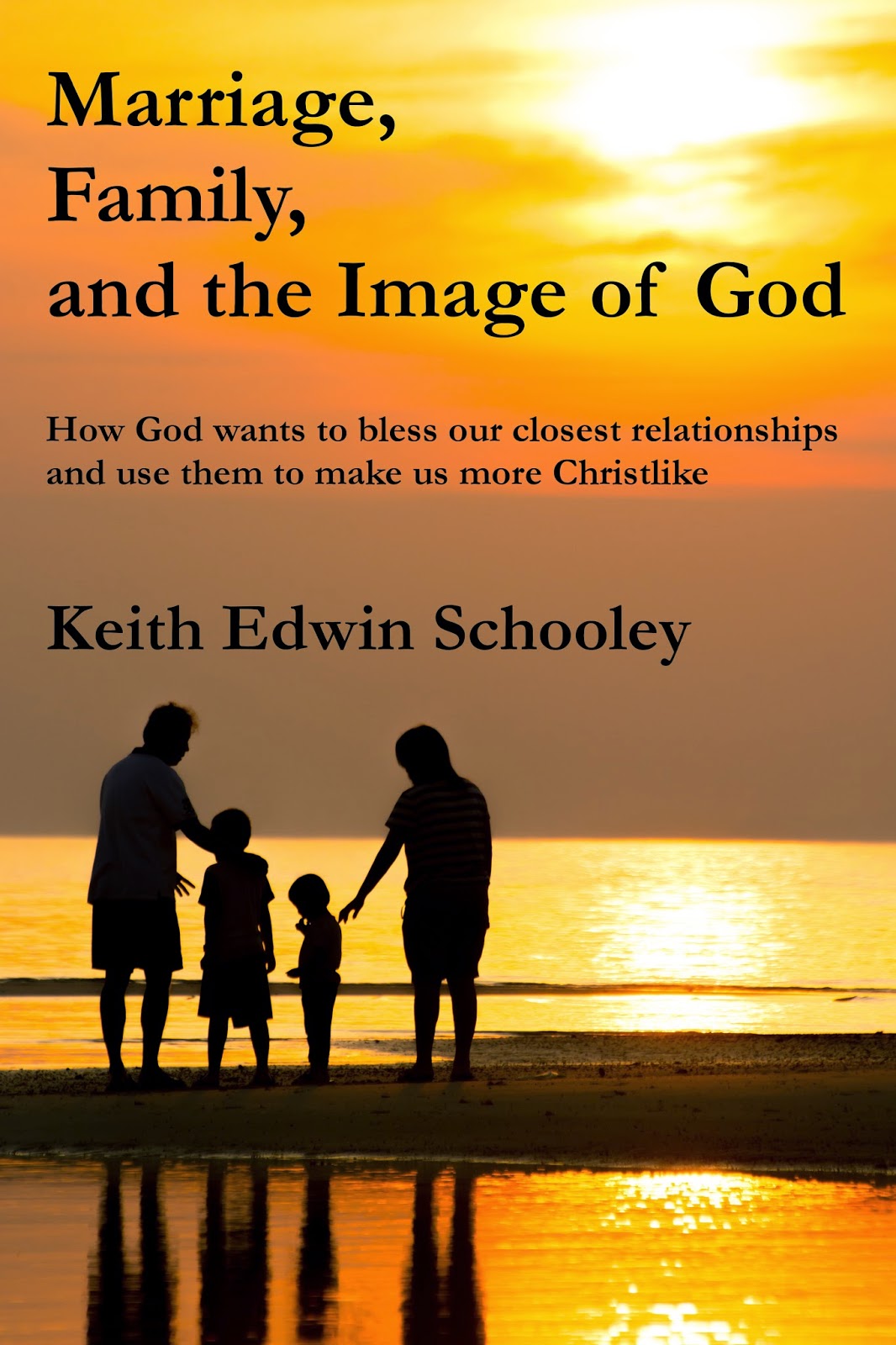
For more on marriage, check out my book, Marriage, Family, and the Image of God .

Marriage, Family, and the Image of God


Wednesday, November 14, 2007

Karate and Coasting in North Dakota

Julie wrote a very thought-provoking post, entitled Wear the purple belt. I'm tempted to summarize it, but that would just make prosaic what she expressed much more eloquently. So if you want to know what her title has to do with my title and how that could possibly be thought-provoking, you'll just have to check it out for yourself.

Wednesday, November 07, 2007

Pat Robertson Endorses Giuliani

Pat Robertson endorses Giuliani.

And the corruption of the "religious right" is complete. Republican politicians don't even have to pretend to support Christian social issues anymore.


Technorati Tags: , , ,

Tuesday, November 06, 2007

Joe Carter Takes a Stand against Waterboarding

Joe Carter writes a fine article taking a stand against torture, including the kind known as waterboarding. He asks, rhetorically, "How degraded has conservatism become?" I'll ask, non-rhetorically, "How has conservatism become degraded?" Especially the Evangelical Christian kind? The progression, it seems to me, went something like this:
  1. Social changes in the 60s and early 70s made certain things socially acceptable that Christians found abhorrent.
  2. The Democratic party tended to ally itself with these social changes. Evangelical Christians migrated toward the Republicans as an alternative, even though many Republicans had no interest in the social conservatism of Evangelicals.
  3. Evangelical Republicans began to adopt aspects of economic and foreign-policy conservatism that had nothing to do with the social conservative agenda. In some cases, this involved soft-pedaling other aspects of biblical social policy, such as concern for the poor. Identity as a conservative began to supersede identity as a Christian.
  4. Evangelical Republicans became increasingly swayed by such voices as Rush Limbaugh, who seemed to support the social conservative agenda, but who much more strongly supported other aspects of conservatism.
  5. Opposing the Republican party, especially the conservative wing, on any issue, became considered caving in to the liberals.
  6. Evangelical Republicans threw their support strongly behind George W. Bush, partly because he was also an Evangelical.
  7. Bush defined his presidency as war against terrorism in the wake of the September 11 attacks.
  8. Conservative Evangelical Christians, to be supportive of Bush and in opposition to liberals, adopted the "oppose terrorists at all costs" mentality.

And here we are.


Technorati Tags: , , ,

Friday, November 02, 2007

Rethinking the Reformation

It's a little late to be talking about Hallo Reformation Day, but Michael Spencer's post is really more about how we should view the Reformation itself. A few highlights:
  • I no longer believe Luther ever intended to slay the Catholic Church and establish the wonder of contemporary Protestantism.
  • I do not believe true Christianity was restored or rediscovered in the Reformation.
  • I’m convinced that it didn’t take long for Protestantism to accumulate enough problems of its own to justify another reformation or two.
  • I believe we ought to grieve the division of Christianity and the continuing division of Protestantism.
  • I no longer believe the theology of the Reformers was the pinnacle of evangelicalism or is the standard by which Biblical truth itself is judged.
No argument here. I wrote about some of this earlier, in The Successes and Failures of the Reformation. It bears repeating, though, if only because of the increasing movement toward judging one's theology, if not one's actual salvation, by the litmus test of the theology of the Reformers.

I purposely left most of Michael's excellent list out. Check it out for yourself.


Technorati Tags: , , , ,